
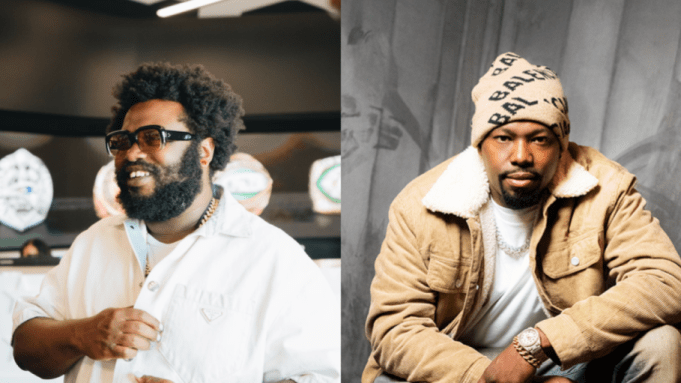
James Fauntleroy and Larrance Dopson have proven their willingness to bet on themselves in times of uncertainty. No further evidence is needed than simply looking at the name of their crew, a testament to their humble beginnings along the road traveled. “We were playing for Bobby Valentino years ago, right before he got his deal for Def Jam,” Dopson says over Zoom, beginning the backstory of the collective’s name.
“He asked us how much we charged. We was like, ‘You got to give us $1,500 or nothing.’ And he’s like, ‘Yeah, what’s the name of y’all band,’ and we were like ‘1500 or Nothing.’ So, you know, just adding more zeros to it. But we kept the name and we stood for something.”
Both figures are often sequestered in the shroud of artistry, preferably heard rather than seen. Still, standing out remains a non-issue. Over the course of the past two decades, Fauntleroy, Dopson and company are among the most sought-out musicians in the game, boasting a midas touch that has helped create seismic hits for artists across varying genres.
VIBE spoke with James Fauntleroy and Larrance Dopson about being trusted advisors and collaborators to musical icons, the nuance of creating timeless music, and contributing to the most pivotal albums of the past decade.
Each of you have enjoyed success individually, but are both part of the 1500 or Nothin’ collective. What’s the crew’s origin?
Dopson: We started off as a church band. A bunch of hood guys that grew up in church that loved music. We all play different instruments, we’re all together. We’re like rangers, we all taught each other stuff when we were young.
What were key moments that boosted your trajectory?
Dopson: As a band, we worked with Just Blaze a lot. So “Show Me What You Got” was one of our first songs that we were a part of where we got away with playing church music that got on the radio (laughs). We were able to do solos that made it on the radio, so that was amazing, man. That was one of those songs for us as a band that got our name out there. And we were also performing live. So we was either doing studio stuff, writing music or doing live stuff. So, we were always outside, representing and popping it off.
Fauntleroy: My first big song that kind of introduced me to the game and introduced me to banks and accountants was “No Air” by Jordan Sparks and Chris Brown. That came out however many years ago and we’re still here, baby. Still standing.
You mentioned working with Just Blaze. How did y’all link?
Dopson: We met Just Blaze when we were kids, man. I remember the first day we met him, he was at a studio. We were working on Dr. Dre’s record and he met us and he played a beat and he just let us go. He went to go play video games and when he came back, it was nuts. And it inspired him and we’ve just been connecting every time. So whenever he came to L.A., he’d call me if he needed musicians or a choir or whatever. We did “Why You Hate The Game,” that was one of the early ones. We literally did “Why You Hate The Game” and “Show Me What You Got” in the same day. So Just Blaze is the big homie. I love him to death, man, and we definitely learned a lot from Just.
How was it that the crew went from playing in church to doing sessions with Dr. Dre and Just Blaze?
Dopson: I mean, one thing we did, we really were the young people that really cared about music and we took that sh*t seriously, bro. Even at church, we were 14-15, playing for the biggest churches, for the biggest church artists, that really built the name for us. At that time, a lot of producers couldn’t really play instruments or wasn’t really that savvy. We were the musicians that understood space and understood the rules of a producer and a songwriter, too. So that’s what kind of made us separate from a lot of different producers.
Larrance, you mentioned that you had a working relationship with Hov for like 20 years. How did the two of you link?
Dopson: In the beginning, when we did “Show Me What You Got,” I did not know Hov. He’d see me at Baseline [Studios], but it really wasn’t like that until after we did ‘Show Me What You Got,’ we got a relationship then. And shout out to my homie [Young] Guru, he was telling him about us and we ended up being his band. So after we became his band, we started building a relationship to where we could do other songs, like the song we did with Jay and Nip [‘What It Feels Like’] that came out a couple years ago. But we learned a lot from Jay, man. But sh*t, James knew Jay-Z way before I did (laughs). For sure.
You’ve also served as a musical director for Usher, DJ Khalid, Diddy, Snoop and Migos? What does the role consist of?
Dopson: The music director job, they’ve got to trust one person to put the whole show together. So they trust our opinion when it comes to the set list. And we understand human behavior at the highest level, so we’re always thinking about how do you keep an audience’s attention? So by us paying attention to that and knowing music, it gives us the swag to let them know what time it is. Solving problems, man. It’s a real job, bro. During the show, I’m literally talking to five people on five mics at the same time. Talking to the artist on the ears, talking to the sound guy, talking to the monitor guy, talking to the band. Just to make sure it’s flawless and it’s a good show.

James, you’ve worked on some of the definitive albums of the past decade. What would you say was the most immersive musical experience?
Fauntleroy: Working with Bruno Mars on 24K Magic. It was just the most involved process I’ve been a part of and it was really an educational experience. I really learned why he has six diamond [records] because I really was able to see the secret magic that goes into making the kind of music that people love around the world over long spans of time. At least I think I’ve learned, we’ll see in the future if I learned anything (laughs). I think that all the people that you can list off that I’ve worked with, they all have some unique thing that was really helpful for my creative growth and career. I learned something all the time. It was pretty epic.
What elements would you say makes a perfect song?
Fauntleroy: How the listener feels. That’s it. When you hear it and you feel a certain way, you like it. If it makes you feel good enough, you pay some money (laughs).
James, you’ve been known to air your opinion on social media. Has that ever gotten in the way of opportunities?
Fauntleroy: No, I get a lot of people’s business. I can’t speak for the people, but I know I consider [it] this like… it’s art, naturally, but I have a job to do so I treat it like a job. And I I stopped talking sh*t about people on the internet, also, but I will say that anybody that I ever said anything about has hit me within the last month asking me to work (laughs). So whatever I said on the internet, I still feel like that. I would also like to add that (laughs).

How would each of you describe the process when making music?
Dopson: It depends on who we’re working with, but it always starts normally with the conversation. I ask a bunch of questions and from there, we just vibe. Sometimes it’s playing chords, writing songs. It really just depends, but we will always find that one conversation. That one word or something that will spark us to create the song, through conversation.
Fauntleroy: Yeah, same thing. It’s like it really changes depending on what the goal is, but the goal is always, at the end, it’s for the listener. So it’s whatever we have to do creatively that we can make sure the person that’s listening to the song, the experience is gonna matter to them. That’s what you want art to do, to be experienced. And two, you can lose a lot of money chasing money in this business. And being more focused on what other artists are doing than you are on the people listening to the music.
RELATED STORIES
Today's Top Hits
LET’S TALK


COMMENTS
Leave a comment