
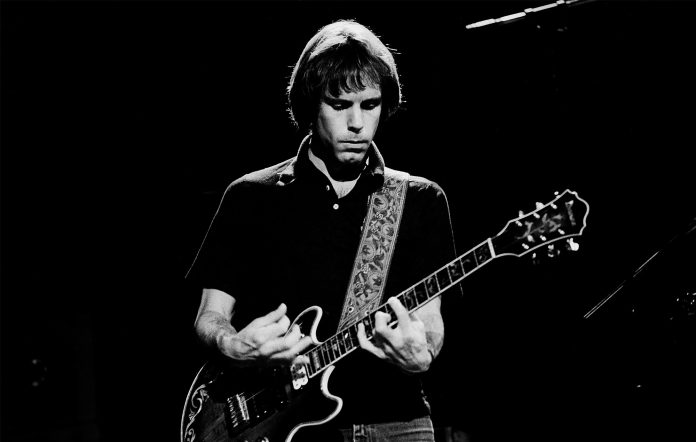
As one of his band’s most enduring songs puts it in ‘Truckin’’, the story of Bob Weir, who died on Saturday January 10 aged 78, really was a long strange trip. As a co founder, guitarist and key vocalist of Grateful Dead, Weir stood at the centre of the psychedelic rock explosion and the wider countercultural shift that swept America in the 1960s. His life moved between extraordinary peaks and real adversity, from helping build the Dead into one of the most formidable touring acts in US history to navigating the challenges that came with longevity. After the death of Jerry Garcia in 1995, Weir became the driving force behind keeping the Dead’s music and spirit alive, doing so through everything from vast reunion concerts to ambitious orchestral reimaginings.
Weir’s early years were marked by upheaval. Born in San Francisco in 1947 to parents who were still college students, he was later placed for adoption. He struggled through childhood with undiagnosed dyslexia and was expelled from nearly every school he attended. At one point, he was sent to a school in Colorado that catered to boys with behavioural difficulties. As a teenager, he found refuge in sport and music. Influenced by jazz records played by a family nanny, he experimented with piano and trumpet before committing to guitar at 13. Under the guidance of Jorma Kaukonen, Weir developed a taste for bluegrass, a path that nudged him closer to the destiny awaiting him. On New Year’s Eve in 1963, while roaming Palo Alto in search of a venue that would let in a 16 year old, he wandered into Dana Morgan’s Music Store, heard banjo music and met Garcia. They played together until morning and soon formed a group called Mother McCree’s Uptown Jug Champions.
The band began as a jug outfit before being pulled toward rock and roll by the success of The Beatles. By 1965 they had renamed themselves The Warlocks and then the Grateful Dead, just as San Francisco’s counterculture scene was looking for local standard bearers. Their first show in December of that year took place at one of Ken Kesey’s Acid Tests in San Jose. The group soon became closely associated with the events and also appeared at the landmark 1966 Trips Festival. Owsley Stanley, who supplied the LSD for many of these gatherings, stepped in as their financial supporter.

It was in these early communal spaces that Weir and the band, which at that stage also included bassist Phil Lesh, drummer Bill Kreutzmann and keyboardist and harmonica player Ron McKernan, honed the improvisational instincts that would define them as pioneers of the jam band movement. Their connection bordered on the unspoken. “We speak a language that nobody else speaks,” Weir once told Rolling Stone. His approach to rhythm guitar was especially distinctive, with Lesh describing it as “quirky, whimsical and goofy”.
Through the late 1960s and into the 1970s, the Dead cultivated a fiercely loyal following known as Deadheads, drawn in by marathon live shows that could last four hours or more, with individual songs stretching well past half an hour. The band allowed fans to record and trade tapes freely, fostering a unique collector culture and a sense of shared ownership. As a result, despite only scoring a single major hit in their three decade run with 1987’s ‘Touch Of Grey’, their catalogue of 22 albums, including milestones like ‘Workingman’s Dead’ and the double platinum ‘American Beauty’, consistently placed in the US Top 30. They became a uniquely American live institution, filling stadiums and setting records, including a 1977 show at Raceway Park in New Jersey attended by 107,000 people, which stood as the country’s largest ticketed concert until 2024.
Weir’s musical curiosity extended beyond the band. As the Dead leaned further into Americana and country rock, he explored parallel paths, releasing solo albums such as 1972’s ‘Ace’ and 1978’s ‘Heaven Help The Fool’, and fronting the side project Bobby And The Midnites during the 1980s. Internally, the group remained remarkably intact through the decades, even as they were repeatedly shaken by the loss of members to addiction. Their popularity peaked commercially with 1987’s ‘In The Dark’. It was only after Garcia’s passing in 1995 that the Grateful Dead officially came to an end. In the years that followed, Weir emerged as the guardian of their catalogue, revisiting songs like ‘Truckin’’, ‘Playing In The Band’ and ‘Sugar Magnolia’ with projects including RatDog and Furthur, and reuniting with former bandmates under banners such as The Dead and The Other Ones.
 Jay Lane, Bob Weir and Mickey Hart perform in Dead & Company in 2023. Credit: Miikka Skaffari / Getty Images
In 2015, despite ongoing health issues limiting some performances, Weir took part in three Fare Thee Well reunion concerts at Soldier Field in Chicago to mark the Grateful Dead’s 50th anniversary. These shows were billed as the final performances by the surviving core members, Weir, Lesh, Mickey Hart and Kreutzmann. Later that year, Weir joined forces with Hart and Kreutzmann to form Dead and Company, which went on to become one of the highest earning touring acts in the US. Between May and August 2024, the group staged a 30 night residency at The Sphere in Las Vegas, ranking among the most successful residencies ever mounted.
Alongside this, Weir continued to release and perform new material. He issued his final solo album ‘Blue Mountain’ in 2016, reunited with Lesh as Bobby and Phil, and launched the trio Wolf Bros with Don Was and Jay Lane in 2018. In his later years, his commitment to the Dead’s music never wavered. He curated Dead Ahead festivals in Cancun, performed orchestral versions of the band’s songs in the US and London, and played his final Dead and Company show at San Francisco’s Golden Gate Park to celebrate the band’s 60th anniversary. His resilience remained striking to the end. After overcoming a cancer diagnosis in 2025, he later died from complications related to longstanding lung issues.
Weir’s influence on American rock was perhaps best captured by the 2015 tribute collection ‘Day Of The Dead’, assembled by Bryce Dessner of The National. The box set brought together an extraordinary range of artists including The Flaming Lips, Sharon Van Etten, Kurt Vile, Stephen Malkmus, The War On Drugs and Perfume Genius. Across rock music tonight, freak flags fly at half mast.
RELATED STORIES
Today's Top Hits
LET’S TALK

COMMENTS
Leave a comment